
Saptrishi Soni
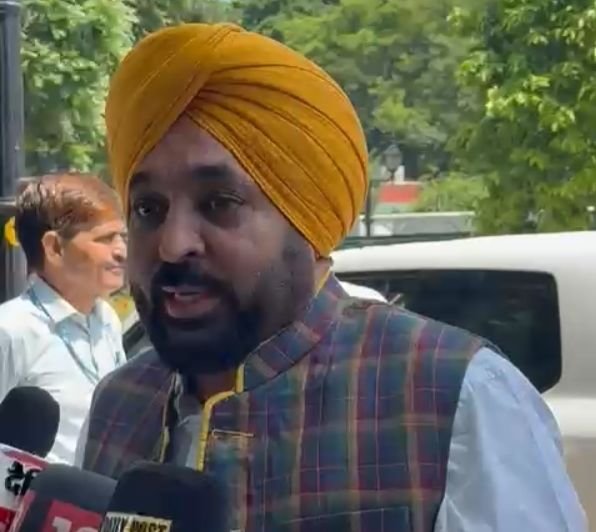
Punjab Chief Minister Bhagwant Mann’s decision to personally approach Governor Gulab Chand Kataria over parole for Jagtar Singh Hawara has brought a highly sensitive issue back to the centre of Punjab’s political discourse.
Mann met Governor Kataria at Raj Bhavan on Wednesday and sought a 10-day parole for Hawara, citing the deteriorating health of his elderly mother and her desire to meet her son after more than three decades. The Chief Minister had already written to the Governor on August 8, describing the request as one based on humanitarian considerations.
The move is politically significant because Hawara is serving a life sentence in connection with the 1995 assassination of then Punjab Chief Minister Beant Singh. His case therefore carries a very sensitive security, legal and political history.
But Mann’s approach has carefully focused on a different dimension: a son meeting his ailing mother.
That distinction could become important for the Aam Aadmi Party as Punjab moves towards the 2027 Assembly election.
From a security-sensitive case to a humanitarian question
The Mann government is not seeking Hawara’s release from his life sentence. The request is for a limited period of parole so that he can meet his 81-year-old mother, whose health has reportedly deteriorated with age. Hawara has also approached the Punjab and Haryana High Court seeking parole.
Mann has publicly framed the issue around the mother’s wish to see her son after 31 years.
That framing is politically important.
Punjab has a long and complicated history surrounding militancy, terrorism, incarceration and demands for release or parole of Sikh prisoners. Any government dealing with such cases has to balance humanitarian considerations with law, security and the sensitivities of victims’ families.
By approaching the Governor rather than turning the matter into a confrontation with the constitutional office, Mann has placed the decision within the established constitutional and administrative process.
The final decision does not rest simply with political messaging. It will depend on the applicable legal framework, the prisoner’s status, security considerations and the competent authority’s assessment.
Why this could matter enormously before 2027
For AAP, Punjab is no longer simply an election about governance.
The 2027 contest will also be about identity, social justice, Sikh political sentiment, law and order, agriculture, drugs, employment and the relationship between Punjab and the Centre.
Mann’s political challenge is to ensure that AAP is not defined solely by questions over the economy, government finances or unfulfilled expectations.
The Hawara parole issue allows the Chief Minister to occupy a different political space.
By presenting himself as someone willing to consider a humanitarian appeal even in a politically sensitive case, Mann can attempt to strengthen AAP’s image among sections of Punjab’s electorate that closely follow issues relating to Sikh prisoners and longstanding grievances.
This does not mean that the entire Sikh electorate will automatically move towards AAP. Punjab’s Panthic politics is far more complicated, and several parties and organisations compete for that space.
But the symbolism of the move cannot be ignored.
AAP’s political calculation
The timing is particularly noteworthy.
AAP enters the 2027 election as the incumbent party. It has to defend its record while simultaneously confronting Congress, BJP, SAD and other political forces.
The BJP has been expanding its presence in Punjab. The Shiromani Akali Dal is attempting a political revival, while speculation about a possible BJP-SAD rapprochement has added another layer to the opposition strategy.
In such an environment, every issue capable of influencing Punjab’s rural and Sikh electorate assumes greater importance.
Mann’s approach could therefore help AAP send a message that it is willing to listen to a humanitarian appeal even when the underlying case is politically difficult.
The government can argue that humanitarianism and the rule of law are not contradictory.
Indeed, that could become the central political narrative.
The Opposition’s dilemma
The move also creates a difficult situation for AAP’s opponents.
If Congress, BJP or SAD oppose the parole request outright, AAP can portray them as being insensitive to the plight of an elderly mother.
If they support the humanitarian request, the political space available to attack Mann over the issue becomes narrower.
The opposition is therefore likely to focus on the legal and security dimensions rather than directly opposing the humanitarian argument.
That is where the government’s handling of the issue will be crucial.
Mann cannot afford ambiguity. The government will need to make it clear that the parole decision is subject to law and security assessments and that humanitarian considerations do not amount to political endorsement of Hawara’s past actions.
That distinction could protect the government from the charge of compromising on security.
Why the Governor’s role is equally important
Governor Gulab Chand Kataria now occupies a central position in the matter.
Mann’s decision to meet the Governor personally is significant because it demonstrates that the Chief Minister is willing to use the constitutional mechanism rather than merely make a political announcement.
The Governor’s decision will therefore carry considerable weight.
If the request is accepted, AAP could present the outcome as a humanitarian decision reached through the constitutional process.
If it is rejected, the political narrative could become more complicated, with AAP potentially arguing that the state government had made a compassionate recommendation but the final decision lay elsewhere.
Either way, Mann has already gained political space by placing the request formally before the Governor.
A delicate balancing act for Mann
There is, however, a potential downside.
Punjab’s history means that any decision involving a convict in the Beant Singh assassination case will inevitably generate questions from victims’ families, security agencies and sections of the public.
The government must therefore avoid allowing the issue to become a contest between humanitarianism and national security.
The strongest position for Mann would be to maintain that the request is limited, humanitarian and subject to all legal and security safeguards.
That would allow the government to address Sikh sentiment without appearing to politicise a sensitive criminal case.
Can this help AAP in 2027?
It potentially can, but only as part of a much larger political strategy.
The Hawara issue alone cannot determine the outcome of the 2027 election. Punjab voters will ultimately judge the Mann government on employment, drugs, agriculture, public services, the economy, law and order and the delivery of its promises.
But politics is also about symbolism.
For AAP, Mann’s intervention provides an opportunity to project a Punjab-specific political identity at a time when BJP, Congress and SAD are all trying to define their own relationship with the state’s electorate.
The most important political message for AAP is that Mann is attempting to position himself not merely as an administrator but as a Chief Minister willing to engage with Punjab’s difficult and emotionally charged questions.
That could prove valuable.
The immediate question is whether Governor Kataria will approve the 10-day parole request. The larger political question is what the episode does to the perception of the Mann government.
If handled carefully, AAP can argue that the government has shown compassion without compromising the law.
And in Punjab’s deeply emotional political landscape, that combination—humanity with constitutional restraint—could become an important part of Bhagwant Mann’s political narrative heading into 2027.