
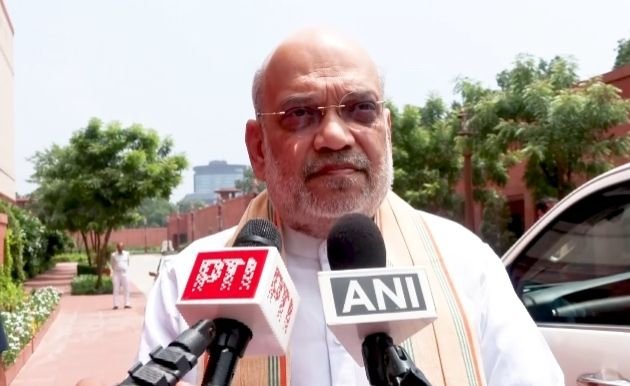
New Delhi, — The continuing confrontation between the Narendra Modi government and the Opposition over the functioning of Parliament has intensified, with Union Home Minister Amit Shah offering to remain in the Lok Sabha for an extended debate while Congress leader and Leader of Opposition Rahul Gandhi rejected what he described as the government’s attempt to turn a serious issue into a lecture.
The dispute centres on protests involving students and the Opposition’s demand for a detailed discussion and accountability over the government’s handling of the issue. Parliament has witnessed repeated disruptions during the ongoing session, with the government accusing the Opposition of deliberately preventing legislative business and the Opposition arguing that protests are necessary to force the government to address issues it believes are being avoided.
Amit Shah’s 24-hour challenge
Mr Shah said the government was prepared for a comprehensive discussion and challenged Opposition parties to submit a formal notice to Lok Sabha Speaker Om Birla.
His proposed arrangement was unusually extensive: if the Speaker permitted it, discussion could begin at 3pm and continue until 3pm the following day. He even offered to allow Question Hour to be suspended to facilitate a longer debate.
Mr Shah said he would remain present, listen to the Opposition’s arguments, take notes and respond to its questions.
The Home Minister’s message was essentially that the government had nothing to hide and that a structured debate would allow Parliament and the public to assess the competing claims.
He also argued that parliamentary procedure requires serious matters to be discussed through established rules rather than being reduced to a standalone ministerial statement.
The government has maintained that it is ready to discuss all issues, but wants the Opposition to allow Parliament to function.
BJP leaders have subsequently intensified their criticism of Rahul Gandhi and other Opposition leaders, asking why they would not participate in a debate if they were confident about their allegations.
Why is the Opposition refusing to accept the offer?
The Opposition’s position is different.
Rahul Gandhi has argued that the issue requires answers and accountability rather than what he sees as a government lecture. Reports from the confrontation indicate that Gandhi questioned the substance and format of the government’s proposed discussion rather than simply agreeing to the arrangement announced by Mr Shah.
For the Opposition, the central issue is not merely whether a debate takes place but whether the government will directly address its allegations and concerns.
This distinction is important.
A government can say that it is ready for debate, while the Opposition can argue that the proposed format does not guarantee that its specific questions will receive satisfactory answers.
That is why the present deadlock cannot be explained simply as one side wanting discussion and the other wanting disruption.
Both sides are also engaged in a political contest over the narrative surrounding Parliament.
The politics behind the deadlock
The confrontation comes at a time when the Opposition, led by Congress and Rahul Gandhi, is attempting to project itself as a stronger parliamentary force.
The 2024 Lok Sabha election reduced the BJP’s numbers compared with the previous Lok Sabha, while the Congress and its allies increased their representation. Rahul Gandhi’s position as Leader of the Opposition has consequently given him a more prominent constitutional and parliamentary role.
For the Opposition, raising contentious issues aggressively in Parliament is a way of keeping public attention on questions it believes could politically damage the government.
For the BJP-led government, however, repeated disruptions create an opportunity to portray the Opposition as unwilling to engage in substantive debate.
That is precisely the argument Mr Shah made when he said that the public would ultimately decide who wanted discussion and who was avoiding it.
The government is therefore trying to turn the parliamentary deadlock into a political question of credibility.
Rahul Gandhi’s dilemma
For Rahul Gandhi, the situation carries its own political risks.
If the Opposition continues to disrupt proceedings without accepting a debate, the government can argue that it was offered an opportunity to put its allegations on record but chose confrontation instead.
If the Opposition accepts the debate, however, it gets an opportunity to question the Home Minister directly and place its allegations on the floor of Parliament.
The choice is therefore not straightforward.
The Opposition’s strongest argument is that parliamentary debate must produce accountability rather than simply give the government another platform to explain its position.
The government’s strongest counterargument is equally straightforward: if the Opposition has serious questions, Parliament is precisely where those questions should be asked and answered.
A larger question about Parliament
The dispute highlights a recurring problem in Indian parliamentary politics: whether disruption is an effective democratic instrument or whether it ultimately weakens Parliament itself.
Opposition parties have traditionally argued that protest inside the House becomes necessary when they believe the government is unwilling to provide adequate discussion.
Governments, meanwhile, argue that repeated disruption prevents other MPs from raising constituency issues and obstructs legislative work.
The current confrontation reflects both sides of that longstanding tension.
There is also a question of timing. With the monsoon session already witnessing repeated disruptions, every additional day without substantive business increases political pressure on both the treasury and Opposition benches.
For the government, functioning Parliament allows it to demonstrate that it can answer criticism and conduct legislative business.
For the Opposition, forcing the government to confront contentious issues publicly is itself a political objective.
Who gains politically?
At present, both sides have something to gain—and something to lose.
The BJP-led government benefits if the public perception becomes that the Opposition is refusing a debate despite the Home Minister offering extensive time for discussion.
The Opposition benefits if it can convince voters that the government’s offer is more about controlling the narrative than providing genuine accountability.
The outcome may ultimately depend on what happens inside the House rather than outside it.
If the two sides eventually sit down for a detailed discussion, the political focus will shift from disruption to the substance of the allegations. That could give Rahul Gandhi and other Opposition leaders an opportunity to question the government directly, while giving Mr Shah the platform he has sought to defend the government’s position.
If the stalemate continues, however, Parliament itself could become the central political battleground.
The immediate question is therefore not simply whether Amit Shah is prepared to debate or whether Rahul Gandhi is prepared to speak.
The larger question is whether India’s government and Opposition can convert confrontation into parliamentary scrutiny.
For the Modi government, the challenge is to demonstrate that its offer of discussion leads to meaningful answers rather than a one-sided presentation. For Rahul Gandhi and the Opposition, the challenge is to demonstrate that their protests are intended to secure accountability rather than prevent Parliament from functioning.
Ultimately, the credibility of both sides will depend on what happens when the microphones are switched on and the debate actually begins.