
At Sangrur’s Lok Milni, Punjab CM highlights 70,000 government jobs, six lakh additional employment opportunities, education reforms, healthcare coverage and rural infrastructure; warns Akali Dal against any alliance with BJP
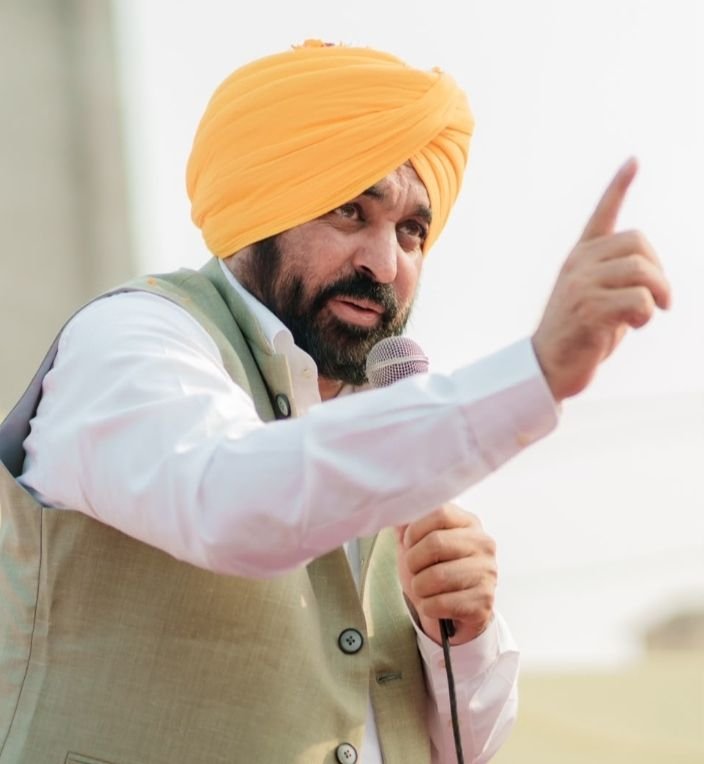
Sangrur : Chief Minister Bhagwant Singh Mann has expressed confidence that the people of Punjab will give the Aam Aadmi Party another opportunity to continue its development agenda in the 2027 Assembly elections, asserting that his government’s performance in employment, education, healthcare, agriculture and rural infrastructure would form the foundation of its appeal to voters. Addressing a gathering during a Lok Milni programme at Moran village in the Dirba constituency of Sangrur district on Saturday, Mann said development was reaching villages across Punjab and claimed that the state was moving away from the politics of exploitation practised by previous governments.
After inaugurating a newly constructed sports ground, the Chief Minister announced a grant of ₹51 lakh for development works in Moran village. He said roads, schools, sewerage systems, playgrounds and other essential facilities were being improved across rural Punjab. Describing public trust as his government’s greatest strength, Mann said the objective was to restore the state’s lost glory and make it ‘Rangla Punjab’ once again.
In a pointed political message ahead of the next Assembly elections, Mann accused the BJP, Congress and Shiromani Akali Dal of having exploited Punjab during their respective periods in power. He alleged that these parties had failed to protect the interests of the state and its people, while claiming that the AAP government was focusing on clean administration and the effective use of public money. He also criticised the Akali Dal over reports and efforts to revive its political understanding with the BJP, recalling the farmers’ agitation against the three farm laws and the deaths of around 750 farmers during the protest at Delhi’s borders. Mann warned that any reunion between the two parties would face a strong response from Punjab’s electorate.
The Chief Minister said his government had provided more than 70,000 government jobs to young people on merit and without corruption. In addition, he claimed that the investment attracted to Punjab had generated over six lakh employment opportunities in the private sector and other areas. He said the government’s priority was to create opportunities within the state so that young people from ordinary families would not have to migrate elsewhere in search of work. The larger objective, he added, was to ensure that children from modest backgrounds could access quality education, secure good jobs and reach senior positions in their professional lives.
Highlighting the government’s sports infrastructure push, Mann said around 3,100 playgrounds were being developed across Punjab to encourage young people to participate in sports and channelise their energy positively. He linked the village-level facilities with Punjab’s ambition to regain its position as a leading sporting state. Referring to Ludhiana hosting the Asian Champions Trophy Hockey Championship, he said the combination of grassroots sports infrastructure and international sporting events would provide fresh opportunities for local players and strengthen the state’s sporting culture. He also underlined the role of sports in keeping young people away from drugs.
On the issue of electricity and public services, Mann claimed that more than 90 per cent of households in Punjab were receiving free electricity under the state government’s scheme. He also said farmers were now receiving daytime power supply, making agricultural operations more convenient. According to the Chief Minister, the closure of toll plazas had resulted in savings of approximately ₹70 lakh every day for commuters. He maintained that government resources were being directed towards public welfare through improvements in schools, hospitals, roads and other infrastructure.
Rural development remained a central theme of the address. Mann said villages should receive the same attention as urban areas and that basic amenities such as roads, sewerage, schools and sports facilities were essential to improving living standards. The ₹51 lakh grant for Moran, he said, reflected the government’s approach of supporting local development requirements and ensuring that infrastructure projects reached communities across the state.
The Chief Minister also highlighted the Mukh Mantri Sehat Yojna, under which eligible resident families are entitled to cashless medical treatment of up to ₹10 lakh. He said the scheme was intended to protect families from the financial burden of major medical expenses and ensure that economic difficulties did not prevent people from accessing treatment. Presenting it as a significant expansion of healthcare support, he said the government wanted to make quality medical services accessible to ordinary households.
He also referred to the Mawan Dheeyan Satkar Yojna, under which eligible women above 18 years of age are to receive monthly financial assistance of ₹1,000, while eligible Scheduled Caste women will receive ₹1,500. The assistance is to be transferred directly into beneficiaries’ bank accounts. Mann said women already receiving social security pensions would also be eligible and claimed that nearly 97 per cent of women in the state were expected to benefit. The government has earmarked ₹9,300 crore for the initiative, he added.
Education, Mann said, was the most effective instrument for addressing poverty and social inequality. He argued that lasting economic empowerment could not be achieved merely through concessions or financial assistance, but required quality education and equal opportunities. Referring to teacher training, the establishment of Schools of Eminence and other reforms in government schools, he said the government was working to provide children from ordinary families with educational opportunities comparable to those available in leading institutions.
To underline the claimed improvement, Mann cited the performance of government school students in the National Eligibility-cum-Entrance Test (NEET). According to the figures shared by him, the number of government school students qualifying for NEET increased from 80 in 2021 to 882 in 2026. He described this rise as evidence of the impact of education reforms and said it demonstrated that talent was not confined to privileged families.
Agriculture and irrigation were other major areas highlighted during the interaction. Mann claimed that canal water had reached the agricultural fields of 1,587 villages that had previously lacked access to this facility. He said the government had invested ₹7,200 crore in strengthening the canal network and expanding irrigation coverage. According to the figures presented by him, the share of agricultural land receiving canal water had increased from 26 per cent to more than 80 per cent since the AAP government assumed office. The area receiving canal irrigation, he said, had expanded from 20.89 lakh acres in 2022 to 60.30 lakh acres.
The Chief Minister also said that nearly 45,000 kilometres of roads were being renovated and upgraded to improve connectivity across the state. Better roads, he maintained, would benefit villages, farmers, traders, commuters and businesses while supporting wider economic activity.
Turning back to the political contest, Mann said the BJP, Congress and Akali Dal had governed Punjab for decades but had failed to resolve many of its long-standing problems. He accused them of prioritising political interests over public welfare and said voters would judge them on their record. His sharpest remarks were directed at the possibility of an Akali Dal-BJP alliance. Recalling the farmers’ protest against the three contentious farm laws, he said the Akali Dal would have to explain to Punjab’s farmers and people why it was seeking an understanding with the party that was in power at the Centre during the agitation. He predicted that if the two parties joined hands, voters would reject their candidates, potentially costing them their security deposits.
In his message on social media after the programme, Mann said the public’s affection and confidence remained the government’s biggest source of strength. He reiterated that the administration’s focus was on clean governance, education, employment and development, particularly for families that had traditionally lacked access to quality opportunities.
With Punjab moving towards another Assembly election, the Moran Lok Milni served both as a public outreach programme and a platform for the Chief Minister to present his government’s performance as an electoral argument. Mann is seeking to position employment generation, welfare schemes, infrastructure expansion, education reforms and agricultural improvements as evidence of a change in governance. The opposition parties, meanwhile, are likely to challenge the government’s claims and raise questions over delivery, finances, law and order and other unresolved issues.
The political significance of the address lies in the AAP government’s effort to turn its development narrative into a renewed public mandate. Mann’s message was that the next election should be fought on the basis of competing governance records, while his attack on the BJP, Congress and Akali Dal indicated that the ruling party intends to make the performance of previous governments a central part of its campaign. Whether these claims translate into another electoral opportunity will ultimately depend on how voters assess the government’s promises, achievements and remaining challenges.