
First coordination meeting at Sukhbir Badal’s residence signals a joint campaign push; seat-sharing, leadership equations and the challenge to AAP will shape the road ahead
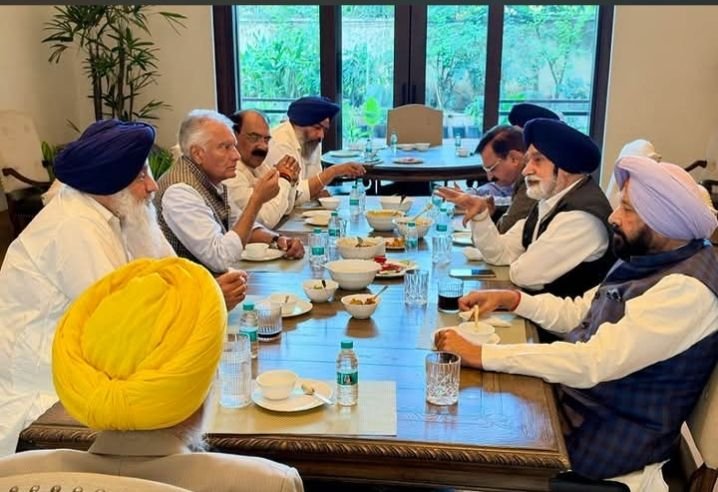
The political contest for Punjab’s 2027 Assembly elections is beginning to take a new shape, with the Shiromani Akali Dal (SAD) and the Bharatiya Janata Party (BJP) moving quickly from announcing their renewed alliance to putting a joint electoral strategy in place. Their first formal meeting after the reunion, held at SAD president Sukhbir Singh Badal’s Chandigarh residence on Saturday, marks an important step towards rebuilding political coordination after six years of separation.
The meeting was not merely a courtesy interaction between leaders who have worked together in the past. With the next Assembly election approaching, both parties have a common political objective: to present a credible alternative to the ruling Aam Aadmi Party (AAP) and improve their electoral prospects through a coordinated campaign across Punjab’s 117 constituencies.
The immediate focus was Prime Minister Narendra Modi’s proposed December 8 rally in Moga, which will commemorate the birth anniversary of former Chief Minister and Akali patriarch Parkash Singh Badal. The event is expected to become the first major public demonstration of the restored SAD-BJP partnership and provide an opportunity to project political unity before the state enters a more intense election season.
The significance of Saturday’s meeting lies in the fact that the two parties are now required to translate an agreement at the leadership level into practical cooperation between their respective state organisations, district units and constituency-level workers.
From political reunion to electoral coordination
The meeting brought together Sukhbir Singh Badal and senior Akali leaders, including Dr Daljit Singh Cheema, Sikander Singh Maluka, Balwinder Singh Bhunder, Bunty Romana and Bikram Singh Majithia. The BJP delegation included Punjab president Kewal Singh Dhillon, former state president Sunil Jakhar, Ashwani Sharma and Anil Sarin.
The discussions centred on preparations for the Moga rally, joint campaigning and coordination between the two organisations. Sukhbir Badal indicated that the parties would work on a common campaign plan over the coming weeks and hold further meetings. BJP leaders also emphasised the need to work together for Punjab’s development and prosperity.
One important aspect, however, remains the division of electoral responsibilities. Although the alliance has been revived for all 117 Assembly constituencies, the precise seat-sharing arrangement has not been formally announced. There were also differing accounts after the meeting about whether detailed seat-sharing discussions had taken place. Sunil Jakhar maintained that the issue was not discussed, while other reports suggested that preliminary deliberations were part of the broader alliance planning. This indicates that the final electoral formula is still to be settled.
The leadership arrangement has received some clarity, with Union Home Minister Amit Shah indicating that the SAD would be the senior partner and would have the right to choose the Chief Minister if the alliance wins. This gives the Akali Dal a central role in the proposed coalition, while the BJP will seek a larger political and electoral footprint in Punjab than it had under the earlier arrangement.
The 2020 rupture and the changed political circumstances
The reunion carries considerable historical and political weight. The SAD and BJP shared power in Punjab in 1997, 2007 and 2012, building a partnership that lasted nearly a quarter of a century. Their relationship, however, broke down in September 2020 when the Akali Dal withdrew from the NDA over the Centre’s three farm laws, which were subsequently repealed.
The separation fundamentally altered the political equations in Punjab. Both parties contested the 2022 Assembly elections independently and again followed separate paths in the 2024 Lok Sabha elections. Neither was able to reproduce the electoral influence that the combined alliance had once enjoyed.
In the 2022 Assembly elections, the BJP won two seats while the SAD secured three. In the 2024 Lok Sabha elections, the BJP failed to win a seat in Punjab, while the Akali Dal managed one victory, in Bathinda. The results demonstrated the difficulties both parties faced in converting their individual organisational networks into broad-based electoral support.
The renewed partnership is therefore as much an exercise in political recovery as it is an attempt to challenge the ruling establishment. For the SAD, the alliance offers an opportunity to regain wider political space by joining hands with a national party possessing a strong central leadership and organisational resources. For the BJP, the Akali Dal provides an established regional network and a partner with a long political history in Punjab.
Moga: More than a commemorative gathering
The choice of Moga for the December 8 rally is politically significant. The district has a special place in the history of the SAD-BJP relationship. It was here, in 1996, that Parkash Singh Badal announced the alliance with the BJP, laying the foundation for a long period of political cooperation.
The proposed gathering on Parkash Singh Badal’s birth anniversary, with Narendra Modi expected to share the platform with Sukhbir Badal, will carry both emotional and electoral messaging. It will allow the Akali Dal to invoke the political legacy of its former patriarch while the BJP will seek to demonstrate its renewed commitment to Punjab’s electoral politics.
The rally will also be an early test of whether the two organisations can mobilise their respective supporters under a common political banner. The size of the gathering, participation from different regions and the presence of grassroots workers will offer an indication of the alliance’s organisational readiness.
However, a large public meeting alone cannot establish the electoral strength of the partnership. The real test will be whether the two parties can sustain coordination beyond major rallies and build a shared campaign around issues that matter to Punjab’s voters.
AAP and Congress face a reshaped opposition landscape
The revival of the SAD-BJP alliance could alter the competitive landscape for the 2027 elections, particularly for the ruling AAP and the Congress, both of which will have to reassess their political strategies.
For Chief Minister Bhagwant Mann and the AAP, the alliance presents a more consolidated opposition challenge. The government is likely to face questions on its performance in areas such as employment, agriculture, drug trafficking, law and order, fiscal management and delivery of welfare promises. How effectively AAP communicates its achievements while responding to criticism will be an important factor in determining its electoral prospects.
The Congress, meanwhile, will have to contend with a reorganised opposition space. Its challenge will be to retain its support base, present a convincing alternative and prevent the SAD-BJP combination from consolidating voters opposed to the present government.
The return of the Akali-BJP partnership also changes the BJP’s position in Punjab. Earlier, the party contested a relatively limited number of constituencies under the alliance arrangement. Its renewed partnership is expected to provide a larger role in the state’s electoral contest. At the same time, the SAD will seek to re-establish itself as the principal regional political force, particularly among traditional Akali supporters.
The biggest challenge: Winning back public confidence
Despite the political advantages of coming together, the alliance faces several challenges that cannot be resolved through leadership-level agreements alone.
For the SAD, rebuilding public confidence after its electoral setbacks and addressing the political consequences of its previous years in government will be essential. Its traditional support base, particularly among sections of the rural electorate, will be closely watched.
The BJP, on the other hand, will have to address questions surrounding its relationship with Punjab’s farming community. The 2020 farm laws remain an important part of the political history of the separation, and the party will need to establish that the differences which led to the breakup have been adequately addressed.
Equally important will be the management of constituency-level ambitions. Both organisations have leaders and workers with their own political aspirations. Deciding which party contests which seat, accommodating local leadership and preventing dissatisfaction among workers will require careful negotiations.
The alliance will also need a common political narrative. Punjab’s electorate is likely to judge the competing parties on concrete issues, including farmers’ income, employment opportunities, industrial investment, drug eradication, public finances, education and healthcare.
2027: A contest that is beginning to take shape
The first joint meeting at Sukhbir Badal’s residence indicates that the SAD and BJP leaderships are conscious of the need to begin preparations well before the election announcement. The proposed Moga rally will be the first major opportunity to demonstrate that the reunion is more than an agreement between senior leaders.
For Punjab, the return of an alliance that once dominated state politics adds a significant dimension to the coming electoral battle. But past political success does not automatically translate into present-day public support. The political environment, voter expectations and the relative strength of competing parties have changed considerably.
The 2027 election is therefore likely to be shaped by three broad questions: whether the SAD can regain its lost political ground, whether the BJP can expand its influence through a regional partnership, and whether AAP and Congress can effectively counter the renewed combination.
The December 8 Moga gathering will offer the first visible indication of the alliance’s political and organisational momentum. The more difficult task will begin afterwards: converting a revived relationship into a credible joint programme, resolving electoral adjustments and winning the confidence of Punjab’s voters.
In the final analysis, the SAD-BJP reunion has made Punjab’s 2027 political contest more competitive, but its electoral success will depend not on the history of the alliance, but on how convincingly the two parties respond to the aspirations and concerns of today’s electorate.