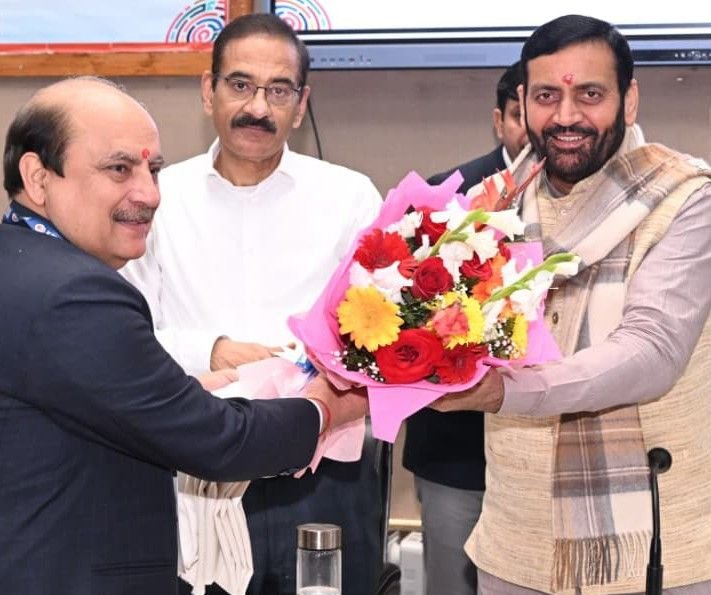
The Haryana government’s budget-making process for the financial year 2026–27 gathered momentum on Thursday as Chief Minister Nayab Singh Saini chaired a major pre-budget consultation meeting in Kurukshetra, engaging directly with a wide spectrum of social, professional, and ideological organizations. The meeting marked another key step in the state’s ongoing effort to build the upcoming budget through structured public participation, positioning the process as a democratic exercise rather than a purely administrative formality.
Addressing representatives from various organizations, the Chief Minister underlined that the forthcoming budget would not be limited to the priorities of any single department, political agenda, or electoral consideration. Instead, he described it as a collective budget of Haryana’s nearly 2.8 crore citizens, framed under the broader national vision of development and governance. He stressed that the government’s objective is to ensure that voices from every section of society are reflected in the final financial blueprint of the state.
The consultation saw participation from a diverse range of organizations, including Bharatiya Kisan Sangh, Bharatiya Mazdoor Sangh, Swadeshi Jagran Manch, Akhil Bharatiya Vidyarthi Parishad, Vidya Bharati, Adhivakta Parishad, Vishwa Hindu Parishad, Krida Bharati, and several other social and sectoral bodies. Representatives placed before the government their suggestions related to agriculture, labour welfare, education, youth development, sports, entrepreneurship, legal reforms, and social development. The wide representation was intended to ensure that policy inputs are not restricted to government departments alone but are shaped by those working at the grassroots and sectoral levels.
Chief Minister Saini described the pre-budget consultation process as a powerful and meaningful democratic tool. He emphasized that such interactions strengthen governance by allowing the administration to understand on-ground realities, sector-specific challenges, and emerging expectations of citizens. According to him, the government is committed to carefully examining all practical and public-interest-oriented suggestions received during these consultations and to incorporating them wherever feasible in the final budget.
He further noted that a balanced and forward-looking budget is essential for Haryana’s long-term development. The Chief Minister stated that the government’s focus is on preparing a budget that goes beyond paperwork and announcements, and instead delivers visible outcomes on the ground in the coming years. He said that the aim is to design a financial roadmap that contributes to making Haryana more self-reliant, economically strong, and socially inclusive.
A key highlight of the meeting was the presentation of an action-taken report on previous pre-budget consultations. The Chief Minister’s Office shared details of how inputs received in earlier rounds had already been translated into budgetary provisions and policy actions. The report was presented by the OSD to the Chief Minister’s Chief Principal Secretary, who explained that many of the earlier suggestions had been implemented and were now showing measurable results at the field level.
Officials informed participants that a total of 11 pre-budget consultation meetings had been conducted across different sectors. These included focused discussions with women’s groups, industry representatives, healthcare stakeholders, rural development and panchayati raj institutions, education and skill development bodies, excise department stakeholders, and incubation and startup ecosystem participants. Inputs from these consultations were said to have played a role in shaping policy priorities related to employment generation, entrepreneurship promotion, and institutional capacity building.
Particular emphasis was placed on the progress made in establishing incubation centres and supporting startups in the state. The government highlighted that several startup-related suggestions had already been implemented, while others related to job creation and enterprise development were currently under active consideration. These initiatives, officials said, are part of a broader strategy to align Haryana’s budgetary planning with emerging economic trends and youth aspirations.
The presence of senior ministers and top bureaucrats at the meeting reflected the importance the government is attaching to the consultation process. Minister of State for Entrepreneurship Gaurav Gautam attended the meeting, along with Chief Principal Secretary Rajesh Khullar, Additional Chief Secretary for Higher Education Vineet Garg, Principal Secretary to the Chief Minister Arun Kumar Gupta, Additional Chief Secretary for Cooperation Vijender Kumar, Principal Secretary for Youth Empowerment and Entrepreneurship Rajeev Ranjan, Principal Secretary for Agriculture and Farmers’ Welfare Pankaj Aggarwal, Principal Secretary for Sports Vijay Singh Dahiya, Commissioner and Secretary for Industries and Commerce Dr. Amit Aggarwal, Additional Principal Secretary to the Chief Minister Dr. Saket Kumar, Deputy Principal Secretary Yashpal, and OSD to the Chief Minister Dr. Raj Nehru.
Through this engagement in Kurukshetra, the Haryana government has signaled that the 2026–27 budget will be shaped through a consultative and participatory framework. The administration is positioning the exercise as a platform where organized voices from across society can influence fiscal priorities, rather than a closed-door process limited to official circles.
As Haryana prepares to present its next budget, the emphasis on dialogue, inclusion, and accountability is expected to continue through similar consultations in other regions and sectors. The government has reiterated that the final budget will aim to reflect collective aspirations, address structural challenges, and lay down a development-oriented financial roadmap that translates public input into tangible policy outcomes for the state.