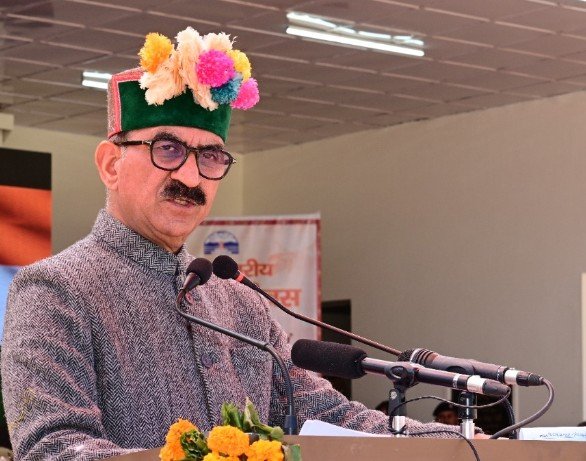
The 79th Himachal Day celebrations at Reckong Peo in Kinnaur district unfolded not merely as a ceremonial tribute to the state’s formation but as a politically charged platform for Chief Minister Sukhvinder Singh Sukhu to project his government’s governance model, welfare priorities and economic roadmap, even as underlying tensions with the opposition continue to shape the political discourse in the hill state.
Presiding over the state-level function, the Chief Minister unfurled the National Flag and reviewed an elaborate parade featuring contingents from police, paramilitary forces, and educational institutions. However, beyond the ceremonial display, the event quickly transitioned into a significant political messaging exercise, with Sukhu outlining a mix of welfare schemes, infrastructure announcements and economic reforms aimed at consolidating public support in a politically sensitive region like Kinnaur.
At the centre of his announcements was a targeted welfare outreach under the ‘Indira Gandhi Pyari Behna Sukh Samman Nidhi’, through which eligible women in Kinnaur district will receive a monthly financial assistance of ₹1,500. This move is being seen as a calibrated attempt by the Congress government to strengthen its connect with women voters, a demographic increasingly shaping electoral outcomes across Himachal Pradesh.
Simultaneously, Sukhu sought to position his government as forward-looking and innovation-driven by announcing geothermal-based central heating systems for households and institutions in Reckong Peo. This initiative, if implemented effectively, could redefine energy use in high-altitude regions and signal a shift toward sustainable development practices—an area where the state government is keen to build a distinct identity.
Infrastructure development also formed a key pillar of the Chief Minister’s address. He announced financial support for critical connectivity projects, including a tunnel to improve access to remote areas and the relocation of a polytechnic college to enhance educational infrastructure in Kinnaur. These announcements were accompanied by assurances that ongoing projects, including day-boarding schools and road networks, would be completed within strict timelines—an implicit response to opposition criticism over delays in development works.
The political undertone became sharper as Sukhu addressed the state’s fiscal situation. Referring to the discontinuation of the Revenue Deficit Grant by the Centre, he framed the issue as a challenge imposed on the state’s financial autonomy. Without naming the Union government directly, the Chief Minister signalled that Himachal Pradesh would have to navigate an estimated loss running into tens of thousands of crores over the coming years. In response, he highlighted his government’s emphasis on fiscal discipline and resource generation, portraying the current administration as resilient and reform-oriented.
In a move aimed at balancing fiscal prudence with administrative morale, Sukhu announced the withdrawal of the 3 percent salary deferment for senior officers while maintaining temporary cuts for top political and bureaucratic leadership. This dual approach appears designed to send a message of shared responsibility while also addressing concerns within the administrative machinery.
The Chief Minister also unveiled a series of measures targeting rural and agrarian constituencies, reinforcing Congress’s strategy of building a broad-based support system among farmers, horticulturists and allied sectors. Enhanced support prices for naturally grown crops, improved returns for dairy farmers and new incentives for fisheries were projected as part of a larger effort to strengthen the rural economy—an area that remains central to Himachal’s socio-economic fabric.
Beyond economics, Sukhu attempted to craft a narrative around governance reforms, particularly in healthcare and education. Announcements regarding advanced medical facilities, including robotic surgery and diagnostic infrastructure, were presented as evidence of systemic upgrades. Similarly, the affiliation of government schools with CBSE and the reported improvement in educational rankings were used to underline the government’s focus on long-term human capital development.
The Chief Minister also touched upon border trade and tourism, announcing the anticipated reopening of trade routes through Shipki-La and efforts to revive pilgrimage corridors. These initiatives, while economic in nature, carry strategic and political significance, especially in border districts where development concerns often intersect with national security considerations.
Politically, the event served as a clear assertion of the Congress government’s intent to dominate the narrative through governance delivery and targeted welfare schemes. By combining cultural symbolism with policy announcements, Sukhu sought to reinforce his leadership image while countering the Bharatiya Janata Party’s persistent attacks on issues such as financial management, law and order, and alleged administrative inefficiencies.
The presence of senior ministers, bureaucrats and party leaders further underscored the importance of the event as a coordinated political exercise. For the Congress, Himachal Day this year was not just about commemorating history—it was about shaping the future political narrative ahead of upcoming electoral challenges.
As the state navigates fiscal pressures, political contestation and developmental expectations, Sukhu’s strategy appears focused on blending welfare-driven governance with region-specific interventions. Whether this approach translates into sustained political advantage will depend on its execution on the ground and the opposition’s ability to counter the narrative in the months ahead.