
Saptrishi Soni:
The Congress has begun shifting its political strategy in Punjab from criticism of the Aam Aadmi Party government to a more organised attempt at rebuilding its electoral machinery, signalling that the battle for the 2027 Assembly election is beginning to take shape at the booth level.
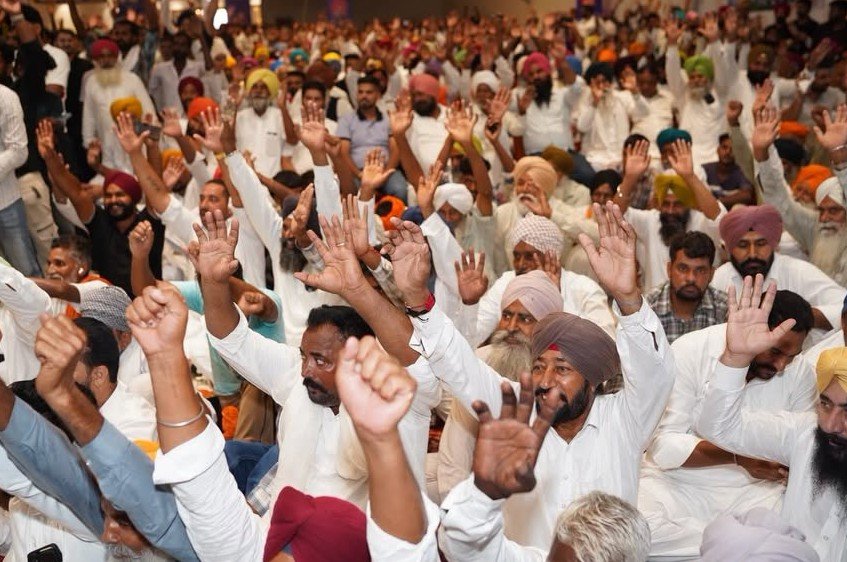
The latest organisational activity has been led by senior Congress leaders, with the party launching a fresh grassroots campaign designed to strengthen its presence among voters and reconnect its leadership with local workers. The move is significant because Congress, despite remaining the principal Opposition party in the Punjab Assembly, has spent much of the period since the 2022 election attempting to overcome internal differences and rebuild its organisational structure.
The party’s recent mobilisation has also come with a sharper political message. Congress leaders have attacked both AAP and BJP, accusing the two parties of creating a political environment in which Punjab’s interests are being overshadowed by wider political calculations. The argument is designed to place Congress at the centre of the Opposition space rather than allow the BJP or Akali Dal to emerge as the principal challenger to AAP.
For the Bhagwant Mann government, the renewed Congress activity is an indication that the political advantage enjoyed by AAP after its historic 2022 victory cannot be taken for granted. AAP won a commanding majority in the 2022 Assembly election, but the political environment has changed considerably since then.
The Mann government is seeking to counter the Opposition campaign through its governance record. The administration has repeatedly highlighted recruitment into government departments, welfare schemes, education reforms, health initiatives and investment proposals as evidence of its performance.
The government’s employment narrative is particularly important. It has presented merit-based recruitment as one of its principal achievements, arguing that government jobs are now being distributed through transparent selection processes rather than political recommendations. AAP leaders are also emphasising private investment as a means of creating employment beyond the government sector.
Congress, however, is expected to focus increasingly on questions of accountability. The party has an opportunity to target the government over issues such as employment, law and order, financial management, public infrastructure and the functioning of government departments.
The recent controversy over examination irregularities has provided another political opening. The issue has already triggered confrontation inside the Assembly, with the government and Opposition exchanging allegations over paper leaks and the treatment of students. The Assembly’s resolution condemning examination scandals has added institutional weight to an issue that is likely to remain politically sensitive because of its direct connection with the future of Punjab’s youth.
Congress will also have to manage its own internal political challenges. A grassroots campaign can succeed only if local leaders and workers remain united and if the party can translate public dissatisfaction into a coherent electoral message. The 2027 contest will not be decided simply by criticism of AAP; voters will also want to know what Congress intends to do differently.
That is where the party’s current organisational push becomes important. Booth-level mobilisation gives Congress the opportunity to identify local issues, strengthen voter contact and rebuild a political network capable of sustaining a long campaign.
AAP, meanwhile, has the advantage of incumbency and control over the state government. Its leaders can point to actual administrative decisions and programmes rather than promises. The challenge for the ruling party will be to demonstrate that these initiatives have produced tangible improvements in the lives of ordinary Punjabis.
The BJP and Akali Dal add further complexity to the contest. If Opposition votes remain divided among several parties, AAP could benefit even in constituencies where dissatisfaction with the government exists. Conversely, if one party succeeds in establishing itself as the principal challenger, the electoral dynamics could change significantly.
Punjab’s political battle is therefore moving beyond speeches and press conferences. It is increasingly becoming a contest of organisation, credibility and competing governance models.
Congress has begun its attempt to rebuild. AAP is defending its record. BJP is looking for expansion, while the Akali Dal is attempting to regain political relevance. The real test will come when these competing strategies reach the voter at the village, ward and booth level.
This is a web generated news report.