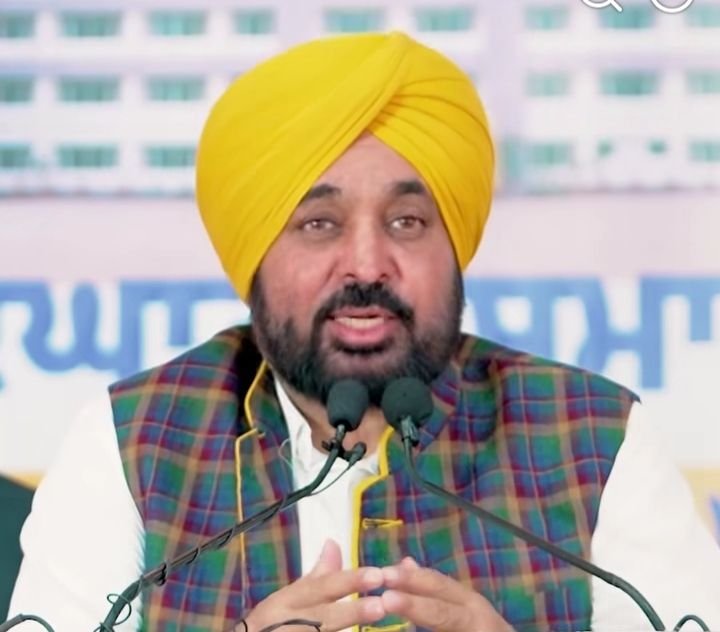
Punjab Chief Minister Bhagwant Singh Mann used his visit to Malerkotla to present a broader account of his government’s performance, linking the inauguration of the new girls’ school to developments in education, healthcare, roads, employment, agriculture and women’s welfare.
The chief minister argued that the state was undergoing a transformation in public services and infrastructure and said the government’s focus was to ensure that ordinary families received better access to education, healthcare and employment.
Education remained at the centre of his address.
Mr Mann claimed that when the AAP government took office in 2022, Punjab’s position in education rankings was considerably lower, but that the state had since emerged as a leading performer.
He attributed the improvement to teacher training, Schools of Eminence and investment in government-school infrastructure.
The government is also attempting to make private-school education more affordable. Mr Mann said legislation had recently been introduced covering around 7,800 private schools and more than 32 lakh students, with schools being directed not to increase fees by more than five per cent.
Healthcare was another major part of the chief minister’s presentation.
He said Punjab now had 1,090 Aam Aadmi Clinics and claimed that more than five crore people had benefited from the facilities.
The government has also promoted its proposed healthcare insurance programme, the Mukh Mantri Sehat Yojana. Mr Mann said the scheme would provide cashless treatment of up to ₹10 lakh to families across Punjab and claimed that residents had already received free treatment worth more than ₹937 crore.
The figures form part of AAP’s attempt to build a political narrative around accessible public services.
The chief minister also highlighted agriculture and irrigation.
He claimed that the use of canal water for irrigation had increased substantially, from about 22% when his government assumed office to 88% currently.
He also said farmers were increasingly receiving electricity during the daytime, which he argued had reduced difficulties associated with agricultural operations.
Road infrastructure was another area highlighted by the chief minister. He said more than 43,000 kilometres of rural link roads were being constructed across Punjab.
On employment, Mr Mann said the government had provided more than 69,000 government jobs based on merit and without recommendations.
Investment was also cited as evidence of Punjab’s changing economic environment. The chief minister referred to investments by Japanese steel company Aichi and Tata Steel, including Tata Steel’s plant near Ludhiana.
Women’s welfare formed another important element of his speech.
Mr Mann referred to the government’s Mawan-Dhian Satkar Yojana, under which women above the age of 18 are eligible for financial assistance. He said 72.13 lakh women were already benefiting from the scheme and described it as one of the country’s largest women-focused social security initiatives.
For AAP, these figures serve an important political purpose.
The 2027 Assembly election will give voters an opportunity to assess the Mann government’s record after a full term in office. The party therefore needs to demonstrate that its promises have translated into projects and services that people can see and use.
Education infrastructure, healthcare clinics, employment numbers and women’s welfare schemes offer the government several measurable areas on which to build its campaign.
At the same time, these claims will face scrutiny from opposition parties, which are expected to question the quality, reach and financial sustainability of the programmes.
The political battle is therefore likely to move increasingly towards competing claims over governance.
For AAP, the strategy is clear: present the Mann government as a service-delivery administration focused on schools, hospitals, jobs and infrastructure rather than traditional political power struggles.
Whether voters accept that argument will become one of the central questions of the 2027 Punjab election।