
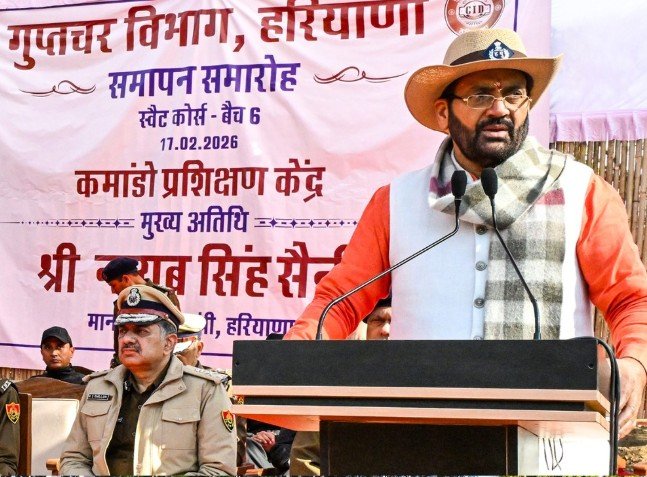
Haryana Chief Minister Nayab Singh Saini has outlined an ambitious vision to position the state’s law-and-order framework as a national benchmark, underscoring large-scale investments in police modernisation, advanced training and technology-driven governance. Addressing the valedictory ceremony of the sixth batch of the SWAT Commando Course at the Commando Training Centre in Panchkula, the Chief Minister reaffirmed that strengthening internal security remains one of his government’s highest priorities.
Speaking as the chief guest at the ceremony, Saini declared that Haryana is committed to equipping its police force with modern infrastructure, state-of-the-art weaponry and cutting-edge training systems to meet evolving security challenges. He announced that ₹300 crore is being spent on police modernisation initiatives across the state, while the recruitment process for 5,500 new police personnel is currently underway to further reinforce the force.
The event also marked the inauguration of a virtual firing training centre built at a cost of ₹85 lakh. The facility integrates advanced simulation technology to replicate real-world combat scenarios, enabling personnel to practice high-risk operations in a controlled and safe environment. According to the Chief Minister, the centre will significantly improve reaction time, precision and decision-making capabilities of officers while ensuring scientific, data-driven and outcome-oriented training.
The Panchkula Commando Training Centre, established in 1984 and operational since March 1985, has evolved into one of Haryana Police’s premier institutions for specialised training. Spread over approximately 12 acres, the centre currently conducts 12 specialised courses, including the Basic Commando Course and the elite SWAT Commando programme. So far, more than 25,700 personnel have been trained at the facility, serving both the state and the nation in critical operations.
Congratulating the 88 personnel — including 11 Probationary Sub-Inspectors and 77 other ranks — who completed the sixth batch of the SWAT course, Saini described their graduation as more than a ceremonial achievement. He stated that becoming a SWAT commando signifies assuming responsibility as one of the most capable guardians of the state’s security. The trainees have undergone rigorous instruction in anti-terror operations, close quarter battle tactics, drone operations, improvised explosive device handling and advanced firefighting techniques.
The Chief Minister highlighted that contemporary security threats have moved beyond conventional crime. Terrorism, organised crime syndicates, cyber-enabled attacks and drone-based threats present new and complex challenges. In this environment, he said, specialised units like SWAT play a critical role in maintaining stability and rapid response capabilities. He assured that the Panchkula training centre will be further upgraded with simulation-based modules, virtual reality systems and enhanced inter-agency joint exercises to keep pace with emerging threats.
Politically, Saini’s address reinforced his broader governance narrative focused on accountability, security and technological advancement. He emphasised that the state government is continuously working to upgrade communication systems, establish cyber laboratories, enhance bulletproof protection equipment and modernise training institutions. The overarching objective, he asserted, is to make Haryana’s policing standards among the best in India.
Highlighting measurable outcomes, Saini stated that crimes against women have declined by 16 percent in 2025 due to strengthened safety measures. Haryana, he said, is at the forefront of the fight against cybercrime, having prevented 36 percent of fraudulent financial transactions in real time and blocked approximately 1.5 lakh fraudulent mobile numbers. These interventions have reportedly safeguarded ₹256 crore of citizens’ money.
On organised crime, the Chief Minister noted that police have dismantled 426 criminal gangs and facilitated the extradition of 15 gangsters who had taken refuge abroad. These actions, he said, reflect a zero-tolerance policy toward criminal networks and demonstrate the government’s resolve to enforce the rule of law without compromise.
Saini also reiterated his administration’s commitment to a “Drug-Free Haryana” under Action Plan 2029. He announced the introduction of the ‘Trakia’ barcode system at the Forensic Science Laboratory in Madhuban, describing Haryana as the first state in the country to implement such a tracking system from police station level to forensic examination. This innovation, he said, enhances transparency and strengthens the evidentiary chain in criminal investigations.
Emergency response systems have also seen improvement, with the Dial-112 service achieving an average response time of 9 minutes and 44 seconds. The state has deployed 30 companies of the Durga Shakti Rapid Action Force and integrated 33 Durga Shakti vehicles into the Haryana-112 emergency network. Additionally, 33 women police stations have been established across the state, along with 239 women assistance desks in remote areas to provide immediate support to women in distress.
The ceremony concluded with the Chief Minister honouring outstanding trainees with trophies and observing live demonstrations by the newly trained SWAT commandos. The display included walk-about drills, hostage rescue simulations, yoga endurance routines, tile-breaking feats and live firing exercises, underscoring the operational readiness of the elite unit.
Senior officials, including Director General of Police Ajay Singhal and Additional Director General of Police (CID) Saurabh Singh, praised the Chief Minister’s sustained focus on police welfare and reforms. They credited the state leadership for ensuring that morale within the force remains high and that professional training standards continue to improve.
As Haryana navigates an increasingly complex internal security landscape, Chief Minister Nayab Singh Saini’s emphasis on modernisation, recruitment and technology-driven policing signals a strategic shift toward institutional strengthening. By combining infrastructure investment with measurable enforcement outcomes, the Saini government is seeking to embed law and order at the centre of its political and administrative agenda — projecting Haryana not merely as a stable state, but as a national model in security governance.