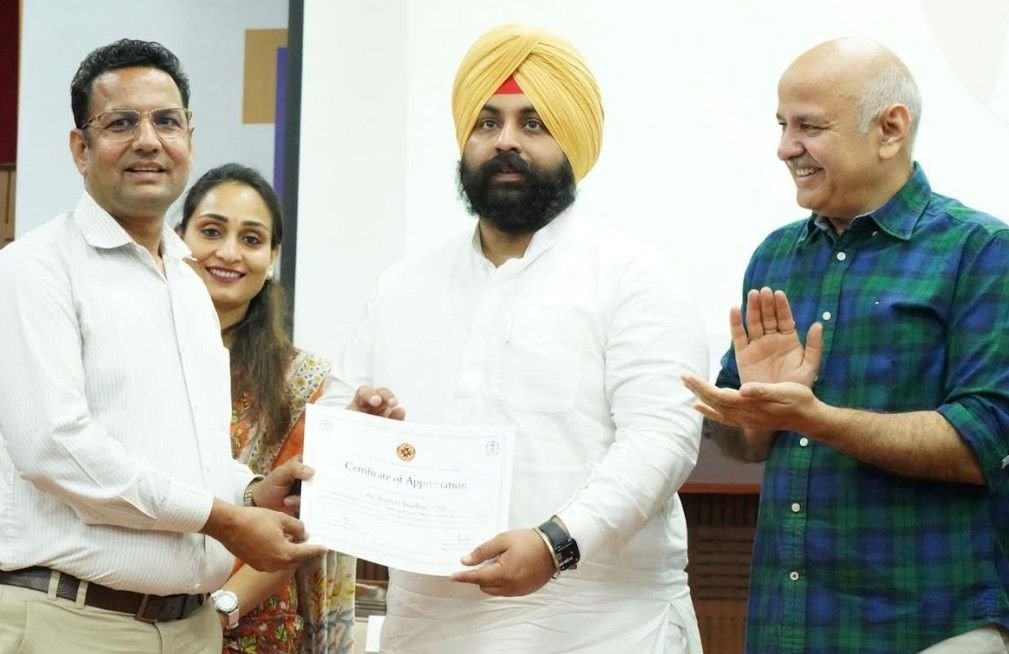
As electoral currents begin to shape the political landscape in Punjab, the ruling Aam Aadmi Party government has intensified its focus on education reforms, positioning its flagship initiatives as both governance milestones and key electoral talking points. In a significant move, Education Minister Harjot Singh Bains, alongside senior party leader and former Delhi Deputy Chief Minister Manish Sisodia, launched Mission Samrath 4.0—an advanced phase of Punjab’s widely publicised “Sikhya Kranti” (education revolution).
The programme introduces a state-wide real-time attendance monitoring system, under which parents will receive daily SMS alerts regarding their child’s presence in school. The initiative is being projected as a transformative step towards accountability, aiming to ensure consistent attendance, strengthen classroom engagement, and improve learning continuity across government schools. Officials indicate that prolonged absenteeism will trigger escalating intervention mechanisms, including district-level outreach and eventual state-level monitoring.
The launch comes at a politically significant moment, with the ruling government keen to showcase tangible governance outcomes amid increasing scrutiny from opposition parties. Education, long considered a weak link in public service delivery, is now being framed as a flagship success under Chief Minister Bhagwant Singh Mann, who has substantially increased the sector’s budgetary allocation in recent years. The state government claims that the education budget has risen sharply, enabling direct investment in infrastructure, staffing, and academic delivery systems.
Minister Bains asserted that Punjab’s top ranking in the national PARAKH assessment has provided the foundation for the next phase of reforms, which now seek to move from recognition to measurable results. He emphasised that the focus is no longer limited to policy announcements but extends to classroom-level execution, where attendance, teaching quality, and learning outcomes are closely monitored.
Mission Samrath 4.0 builds upon a level-based teaching approach, where students are grouped according to their learning capabilities rather than grade levels. The programme, already covering lakhs of students and tens of thousands of teachers, aims to ensure that foundational skills in reading, writing, and mathematics are strengthened, particularly among middle-grade students. Government data suggests that Punjab has recorded improvements above the national average in foundational learning metrics, which the administration is using to reinforce its governance narrative.
Former Deputy Chief Minister Manish Sisodia, who played a central role in Delhi’s education reforms, framed Punjab’s model as a national benchmark. He argued that the introduction of real-time attendance tracking represents a shift from rhetoric to accountability, where even small administrative interventions—such as informing parents of daily attendance—can have a profound impact on learning outcomes. His remarks also carried broader political undertones, suggesting that governance should be measured by visible outcomes rather than promises.
However, the initiative is not without political contestation. Opposition parties have increasingly questioned the government’s claims, arguing that while infrastructure and systems may have improved, deeper structural challenges in education—such as teacher shortages in certain areas and long-term quality benchmarks—still need sustained attention. Critics have also framed the timing of such large-scale announcements as part of a broader pre-election strategy aimed at consolidating public support.
The ruling AAP, on the other hand, has positioned education reforms as a cornerstone of its governance philosophy, drawing parallels with its earlier successes in Delhi. By foregrounding measurable outcomes, including improved rankings and enhanced infrastructure, the party aims to counter opposition narratives and present itself as a performance-driven administration.
Senior officials in the education department have indicated that Mission Samrath 4.0 will also standardise best teaching practices across schools through a structured compendium developed by educators. This is expected to ensure consistency in delivery and provide targeted support to students who require additional academic assistance.
As Punjab moves closer to the next electoral cycle, the education sector is emerging as a central battleground—not just in terms of policy, but also political messaging. The government’s emphasis on accountability, transparency, and measurable improvement reflects a broader attempt to redefine governance benchmarks, while opposition parties continue to challenge these claims on the ground.
In this evolving political environment, Mission Samrath 4.0 is more than an education reform—it is a strategic instrument in shaping public perception, where classroom outcomes and electoral outcomes may increasingly intersect.