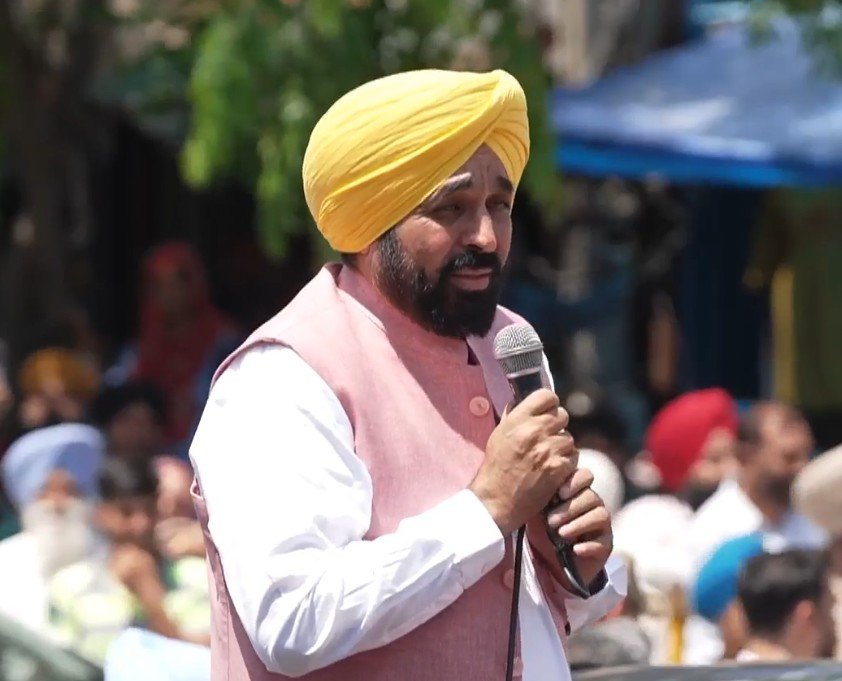
Punjab Chief Minister Bhagwant Singh Mann on Tuesday alleged that the Bharatiya Janata Party was seeking to create an atmosphere of fear and instability in Punjab in the run-up to the next Assembly elections, intensifying political rhetoric as the state enters a crucial electoral phase.
Speaking to journalists after offering prayers at Takht Sri Keshgarh Sahib in Anandpur Sahib, the Chief Minister linked the alleged attempts to the recent passage of the state’s anti-sacrilege legislation. He suggested that the law, which provides for stringent penalties in cases involving desecration of the Guru Granth Sahib, had unsettled political opponents and altered the broader narrative in the state.
Mann’s remarks came as he launched the government’s four-day ‘Shukrana Yatra,’ a statewide outreach initiative aimed at highlighting the significance of the new law and expressing gratitude to citizens for their support. The campaign, which began from Anandpur Sahib, is expected to traverse multiple districts before concluding later this week, combining political mobilisation with symbolic religious engagement.
Addressing the media, the Chief Minister asserted that Punjab has historically upheld communal harmony and social cohesion, and warned against what he described as deliberate attempts to disturb this balance. He accused the BJP of adopting divisive strategies in states approaching elections, alleging that such tactics were intended to polarise communities and influence voter sentiment.
“The people of Punjab value peace, unity and mutual respect,” Mann said, adding that any effort to introduce तनाव or mistrust would be firmly resisted by the public. He maintained that the state government remains committed to preserving law and order while ensuring that sensitive issues, particularly those linked to faith, are handled with seriousness and accountability.
The Chief Minister also positioned the anti-sacrilege law as a central pillar of his government’s governance agenda, arguing that it reflects a strong institutional response to an issue that has historically triggered unrest in the state. By placing the legislation at the centre of the ongoing outreach campaign, the administration appears to be reinforcing its commitment to both religious respect and legal deterrence.
Political observers view the development as part of a broader escalation in pre-election positioning, with parties sharpening their narratives on governance, security and identity. Mann’s statements signal an effort to consolidate support by framing the electoral contest around issues of stability and cultural sensitivity, while also countering opposition criticism.
As Punjab moves closer to the electoral cycle, the tone of political engagement is expected to intensify further, with competing narratives seeking to shape public perception. For now, the Chief Minister’s remarks underscore the growing intersection of governance decisions and electoral strategy in one of India’s most politically dynamic states.